

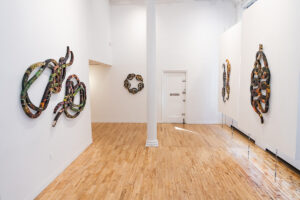
Unreliable Narrators: Rochelle Voyles
by Will Kaplan, ArtSpiel
March 31, 2026
In Unreliable Narrators, Rochelle Voyles’s collages hold both a capacious nihilism and a hope to build stories from the void. From this fulcrum, I think of Joan Didion’s classic essay The White Album, and its opening truism: “We tell ourselves stories in order to live.” Voyles’s compositions of found photographs extend to viewers, a branch, a bone, a tool in making sense of the randomness that seems to rule our lives. Cutouts layered into loops capture chaos, but the care in each cut, the curation, and the collision of hyperspecific images betray a belief in an idiosyncratic order. These works are at once figurative mazes of manifold meaning, and objects calculated to short-circuit our thinking and experience pure sensation.
“Flash pictures in variable sequence, images with no ‘meaning’ beyond their temporary arrangement.” That’s how Didion describes a mental break; it sounds eerily familiar to anyone who scrolls through social media. Voyles describes this dissonance, this dissociation with her dense mix of eclectic images. Yet color and composition cohere the components into an unruly whole.
Look past the tentacular form of the instantly aquatic Neptune in Pisces. What are we to make of the menacing bird camouflaged into the curls, or the rocket ship blasting into cerulean sky? The specificity of blue disguises these aerial items within the submarine scheme, while their shapes keep our eye in motion. These embedded tensions disrupt the setting and produce a wave of compounding, fluid jolts.
Didion casts doubt on this connective impulse, on “the ‘ideas’ with which we have learned to freeze the shifting phantasmagoria which is our actual experience.” This is one of art’s greatest aims: to let a still image resonate deeper than “ideas.” Equal parts frozen and phantasmagoric. At its highest power, an artwork can cut through thought and open up pure experience unbridled by narrative or words. The Abstract Expressionists, for example, pursued this by abandoning figuration and embracing the physicality of scale and gesture; of course, many words—in essays, or slurred together at the Cedar Bar—were spent scaffolding their efforts.
Remarkably, Voyles’s hyperfigurative works accomplish both this climactic burst of sight and the slippery promise of meaning. The swarm of nearly nameable pictures is subsumed but not constricted by formal elements. Take the emberlit Slithering Ruin. Does it matter that the testifying man is Nixon’s White House Counsel, John Dean, photographed at the Watergate Trial? Need we recognize a statue of Shiva the Destroyer or the adjacent photo of a flooded New Orleans? The answer is no.
Read the full article: