

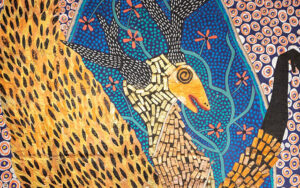
‘Hallel’ | Downtown gallery with local owner showcases Oren Fischer’s art
by Joanne Palmer, New Jersey Jewish News
August 13, 2026
To walk into 81 Leonard Gallery in lower Manhattan is to be overwhelmed by the color. Huge pieces of art, with enormous expanses of bright color.
It’s not intimidating, it’s not off-putting, and most certainly it is not saccharine. It’s immersive. It’s encompassing. It makes you want to keep looking at it
A lot of it makes you happy.
It’s an exhibit called “Hallel,” by Israeli artist Oren Fischer. As 81 Leonard Gallery’s creator and owner, the painter Nancy Pantirer of Short Hills, puts it, it’s spiritual. “They’re overwhelming in size, so you’re taken in by them right away,” she said.
“Oren is a multimedia artist, and when you step inside the gallery, you feel that,” Hannah Rothbard, an artist and curator who’s the director at 81 Leonard Gallery, said. “He is working across textiles, paintings, sculpture, wearable art. It’s like he’s making everything, and you can see his hand in all of it.”
He’s also a performance artist; when you click on his homepage, www.orenfischer.com, you see a thin, black-clad, angular man — presumably Oren — with red shoelaces and his underwear at times sticking up through his pants, flailing and dancing and monkey-walking through Tel Aviv and a Chagall exhibit and what appears to be a hospital. It’s striking.
“He wants you to walk in and be surrounded by this spiritual history, the idea that every Israeli person, every Jewish person holds this history within them,” Ms. Pantirer said. “So much of this work is about Israeli identity and experience.
“There are some biblical references, and there are references to folklore. There’s a Shabbat table, and wooden sculptures that represent both Jews and Arabs as members of Israeli society. He’s critical of the government in one of these pieces, called ‘Mother’s Plight.’ It’s a mother holding a soldier, who is her child, and the soldier is holding a rifle aimed at her womb. So she’s pregnant, but the baby is being killed. It’s the idea of the cycle of violence, and the idea of sacrifice.
“But at the same time, he is Israeli, and he feels the same pain that everyone feels at the loss.”
The exhibit, though, overwhelmingly is “a nuanced view of Israeli society, but also a celebration of culture and joy.”
Read the full article: