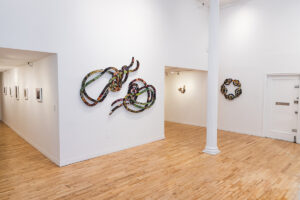
In Unreliable Narrators, Rochelle Voyles turns found images into shaped collages that hold labor and pleasure, gender and myth, softness and dread, without forcing any of it to resolve.
Rochelle Voyles does not make work that settles. In Unreliable Narrators, her solo exhibition on view through April 11th, shaped wood collages built from found paper ephemera become a way of thinking through gender, labor, history, and the instability of images themselves. The works are materially dense and visually active, but what gives them their edge is something quieter: a refusal to land. Voyles is not trying to deliver a clear message or resolve a tension. Instead, she lets fragments collide, then steps back just enough for the viewer to feel implicated in the act of making meaning. [Read on]
“I’m attempting to describe a narrative,” she says. “But I recognize it’s unreliable.” That admission is not a limitation. It is the structure of the work.
The image was never neutral
Voyles works with found images, but she does not treat them as stable evidence. Every photograph arrives already shaped by the person who took it, the context it came from, and the details it leaves out. By the time it reaches her, it is already partial. She cuts into it, rearranges it, and builds something new, adding another layer of subjectivity rather than correcting the first.
She is direct about this. She is selecting, composing, and narrating. Her version is just as skewed. Rather than disguising that instability, she leans into it, allowing the work to hold together without pretending to be definitive. The collages guide you, but they never close. You are not told what to think. You are asked to stay inside the act of looking.
False binaries
That distrust of certainty extends beyond images to identity itself. Growing up, Voyles struggled with what a girl was supposed to be, and how femininity was depicted in the media. The expectations felt narrow, prescribed, and difficult to inhabit. There is humor in how she recalls wanting to be a cowboy, a mob boss, and a ninja, but the frustration underneath that memory still runs through the work.
Her queerness and neurodivergence sharpen that awareness, but the work reaches further, examining how identity is constructed through images and how easily those constructions become limiting. Across the exhibition, binaries appear only to begin falling apart. Male and female, right and wrong, black and white—these categories do not hold under pressure. They expand, collapse, and reveal something more unstable in between.
That tension shows up in the forms themselves. Some shapes feel rigid, almost constricted, echoing the limits of stereotype. But that rigidity is not reinforcing the idea. It is exposing it.